
When we look back at Fenerbahçe’s history today, we encounter dates, names and results that appear firmly established. The club’s earliest years, however, are not illuminated by a complete and orderly record. They are reconstructed through brief newspaper reports, personal recollections and studies written many years later.
For this reason, the question “When did Fenerbahçe play its first match?” does not have one final and unchanging answer.
Whenever another newspaper page is discovered, the documented history may move a little further back.
The difference between the first match and the first document
The first match a club played is not necessarily the same as the earliest match for which we can find documentary evidence today.
Accounts suggest that Fenerbahçe may have faced different teams during 1907. Some period sources also mention a 9–0 defeat against a Kadıköy side. The precise date and details of that encounter, however, have not yet been established with sufficient certainty.
The match discussed here should therefore not be described as the first time Fenerbahçe ever took the field. It is the earliest written match record for which a precise date can currently be identified.
The date accepted for many years
Rüştü Dağlaroğlu, the author of one of the foundational works on Fenerbahçe’s history, recorded the match against Moda on 6 September 1908 as the club’s first significant fixture.
Dağlaroğlu treated the games played before this encounter more as practice or preparatory matches. The Moda match of 6 September 1908 was consequently accepted for many years as Fenerbahçe’s first serious match.
As older newspapers were examined, however, reports of earlier fixtures began to emerge.
A May morning in Kalamış
The 3 May 1908 issue of the newspaper Tercüman-ı Hakikat contained a report about a match between Fenerbahçe and the newly established Üsküdar team.
The game had been played in the morning at Kalamış Meadow on Friday, 1 May 1908. The newspaper described it as a form of practice match and reported that Fenerbahçe won 5–1.
With the discovery of this report, Fenerbahçe’s documented match history moved back from 6 September to 1 May 1908.
The research did not end there.
A second record from the same month
Another match appeared in the 20 May 1908 issue of the same newspaper.
On 17 May, Fenerbahçe faced a combined team formed by players from the Kadıköy and Elpis clubs at Kalamış. The match ended in a 3–3 draw.
The fixture was significant not only because of its result, but also because it revealed the structure of football in Istanbul at the time. Teams and squads were not separated by boundaries as fixed as those we recognise today. Players from different clubs could appear together under one side.
Fenerbahçe itself was still in the earliest stage of forming its institutional identity.
Eight goals at Papazın Çayırı
On 5 July 1908, Fenerbahçe faced Pera.
The match, played at Papazın Çayırı and lasting approximately ninety minutes, ended in an 8–0 victory for Fenerbahçe. A brief report published in the newspaper Sabah the following day stated that both teams had fielded eleven players.
In addition to documenting one of the largest victories of the club’s founding period, the report suggested that Fenerbahçe was already developing into a more organised football team.
The earliest known date, however, had still not been found.
The newspaper clipping that changed the chronology
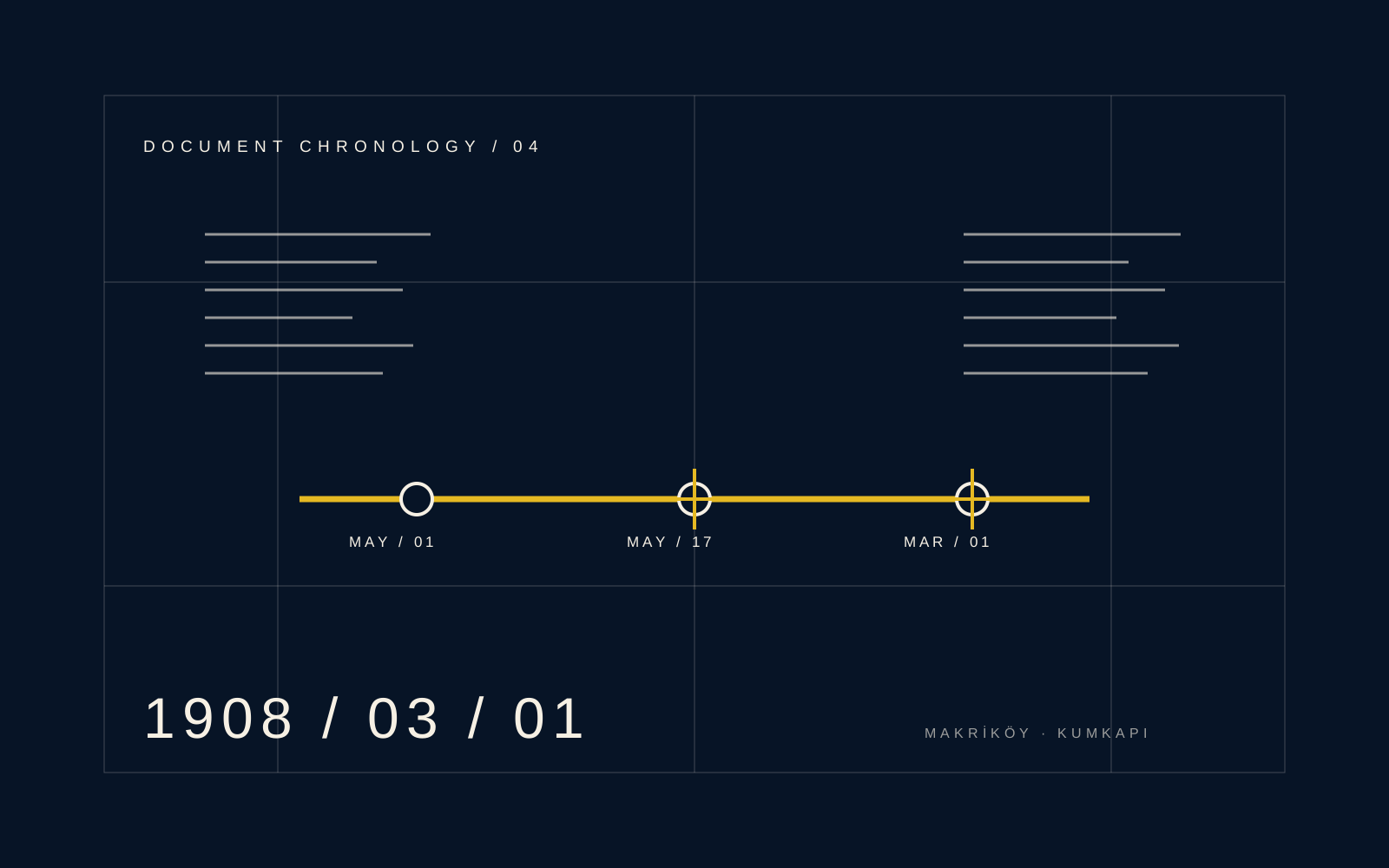
The 7 March 1908 issue of The Levant Herald & Eastern Express included a short report about a match played in Makriköy on the previous Sunday between Fenerbahçe and Kumkapı.
According to the report, Fenerbahçe won the match 4–0.
The previous Sunday was 1 March 1908.
The report therefore established that Fenerbahçe faced Kumkapı on 1 March 1908 and placed the club’s name within the earliest precisely dated written match record currently known.
The accepted chronology had moved first from 6 September to 1 May, and then back to 1 March 1908.
Why history never fully closes
One of the defining qualities of archival research is that our knowledge of the past is never entirely complete.
Another newspaper issue, an unidentified photograph, a brief notice or a family archive left unopened for decades may change what we think we know. The same is true of Fenerbahçe’s founding years.
The club may have played earlier matches for which no document has yet been found. Several accounts suggest that this is a genuine possibility. Historical research, however, must preserve the boundary between possibility and documented information.
What can currently be stated is this:
This does not mean that the club’s first-ever match has been conclusively discovered. It marks only the earliest point the surviving evidence presently allows us to reach.
The Fenerbahçe–Kumkapı match played on 1 March 1908 is the earliest Fenerbahçe match record for which a precise date has been identified.
Fenerbahçe between the records
The locations of these encounters matter as much as their results: Kalamış Meadow, Papazın Çayırı and Makriköy.
Fenerbahçe’s earliest years tell not only the story of a football team, but also that of Istanbul’s changing sporting culture. Clubs were being formed, players moved between different sides and football was beginning to establish a place for itself on the city’s open grounds.
The first traces of the Fenerbahçe that now enters a stadium before tens of thousands of people were preserved in a few short lines printed in old newspapers.
The memory of a club sometimes begins not with a major trophy, but with a small record found at the edge of a forgotten newspaper page.
Source notes
Primary research
Fenerbahçe’nin Belgelenen İlk Maçları
Fenerbahçe Tarihi Çalışma OrganizasyonuView source (opens in a new tab)Last verified: 2026-07-28Supporting source
History of Fenerbahçe Sports Club
Fenerbahçe Spor KulübüView source (opens in a new tab)Last verified: 2026-07-28
This article is not a direct or condensed reproduction of the source research. Its findings have been reconsidered through an original structure and narrative for The 1907 Originals.
COMMENTS / 00
Join the conversation
Sign in with your Google account to leave a comment.
Your name and profile image may appear with your comment. Your email address is not shown publicly.